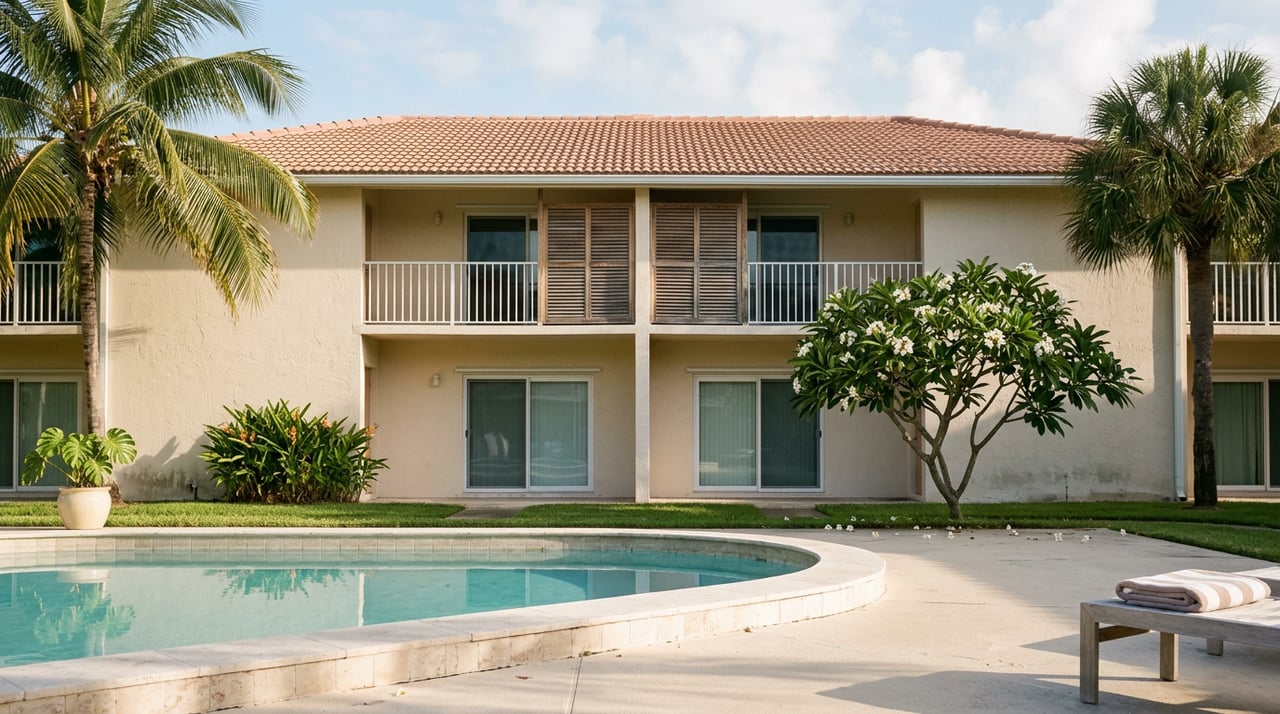
Kihei Condo Bill 9 and Bill 88: What to Know in 2026
August 6, 2026
August 6, 2026
A client called me last month from escrow on a one-bedroom in a well-known South Kihei complex. Her lender had asked a simple question that stalled the file for a week: was the unit's short-term rental income going to be legal in 2031, or wasn't it? The listing said "Minatoya List." The seller's agent said "grandfathered." The appraiser wanted the zoning designation in writing. Nobody in the transaction disagreed about the facts. They disagreed about which facts mattered now that Bill 88 had passed.
If you have been reading the Maui market from the mainland, you have almost certainly seen the Kihei condo story told as one thing. Bill 9 phased out short-term rentals in apartment-zoned Minatoya condos, prices softened, inventory grew, buyers got cautious. All true. But that single story is now covering three different markets, and the price signals in Kihei have not caught up to the split. If you buy a Kihei condo in the second half of 2026 without understanding which of the three tracks your unit is on, you are almost certainly mispricing the risk in one direction or the other.
Here is what I want you to hold onto: the same complex, on the same street, can now contain units with materially different futures. That is the whole thesis. Everything below is evidence for it.
Mayor Bissen signed Bill 9, now Ordinance 5909, on December 15, 2025. It phases out short-term rentals in apartment-zoned (A-1 and A-2) condos on the Minatoya List. West Maui units have until January 1, 2029. Kihei and the rest of South Maui have until January 1, 2031. That is the piece most out-of-state buyers already know.
What most buyers do not yet know is what the Maui County Council did on June 19, 2026. In a 7-2 vote, the Council passed Bill 88, creating two new hotel zoning district categories, H-3 and H-4, that could be applied to as many as roughly 4,500 of the condos otherwise facing the phase-out. The eligibility guardrail matters: to qualify, a property must show vacation-rental use predating September 24, 2020. That date exists to stop the roughly 1,700 non-Minatoya properties from using the new zoning as a back door into the STR market.
"We'll continue to fight alongside our residents that are fighting for housing," said Council Member Keani Rawlins-Fernandez, one of two votes against Bill 88, as reported by the Honolulu Star-Advertiser.
Bill 88 does not automatically save any specific building. It creates a path. Each eligible complex still has to seek rezoning, and Lahaina Strong and other advocacy groups have signaled they will contest applications building by building. That is the mechanism that split the market.
Here is how I actually break Kihei condos down for clients right now:
| Track | What it is | Timeline | Example complexes in South Maui |
|---|---|---|---|
| Hotel-zoned, already safe | Never on the Minatoya List, zoned hotel or resort from the start | No change | Royal Mauian, Mana Kai, Maui Banyan, Kihei Akahi, Sugar Beach Resort |
| Minatoya, likely rezoning candidate | Apartment-zoned, on Minatoya List, meets Bill 88 pre-2020 use test, complex likely to pursue H-3 or H-4 | Uncertain, potentially preserved | Larger established Kihei rental complexes still evaluating |
| Minatoya, on the amortization clock | Apartment-zoned, on Minatoya List, no viable rezoning path or complex not pursuing it | STR use ends January 1, 2031 | Kihei Resort, Maui Vista, Pacific Shores among those flagged in earlier reporting |
The Minatoya List itself contains roughly 7,200 units, with about 1,100 already excluded from Bill 9 because of timeshare approvals or zoning variances. Over 60 percent of the vacation-rental condos in Kihei are on the list, which is why South Maui carries more of this uncertainty than any other submarket on the island.
The tempting move is to sort every Kihei listing into "safe" or "not safe." I would resist that. The middle track is where most of the real strategy lives right now, because it is where a unit's future depends on collective action by the AOAO, timing of rezoning applications, and litigation risk that a solo buyer cannot control but can price.
Kihei is still the most active submarket on Maui. In Q1 2026, 33 single-family homes sold in Kihei, up roughly 65 percent from the same quarter a year earlier, and 59 condos changed hands at a median price of $610,000. That condo median sits well below the island-wide condo median of around $847,000, which is a big part of why the Housing Affordability Index for Maui condos jumped 26 percent year over year in early 2026.
Days on market tell the more interesting story. Island-wide, the median condo took 149 days to sell in June 2026, the longest stretch since June 2014. Single-family homes were running around 153 days year to date. These are patient numbers. They mean the market is not clearing at asking, but sellers who price accurately from day one are still closing.
Here is where the thesis matters. If you look at recent Kihei sales, the market is discounting Minatoya units as a single category rather than pricing each unit's specific probability of ending up on Track 2 versus Track 3. A unit inside a complex whose board has already engaged counsel on an H-3 or H-4 application is not the same asset as a unit in a complex where no such conversation is happening, but they are often trading within a few percent of each other. That gap will close as rezoning applications actually get filed. Buyers who do the complex-level homework before that happens are the ones with the best entry points I have seen in South Maui in several years.
The old due-diligence playbook for a Kihei condo focused on the reserve study, the AOAO minutes, and whether the plumbing had been repiped. All of that still matters. What has been added, and what almost no out-of-state buyer catches on their first pass, is a zoning and governance layer that goes beyond the listing sheet.
Before I let a client sign anything on an apartment-zoned Kihei condo in 2026, we work through this sequence:
None of this is theoretical. I have watched two Kihei transactions restructure in the last ninety days because the buyer ran step three and found a board that was quietly not pursuing rezoning.
The March 2026 Kona low brought significant flooding to parts of South Maui. Kihei Crossroads, a commercial property, took water, and residential areas in lower-lying corridors near Ma'alaea saw drainage issues that were not one-off events. Most of Central and South Kihei sits in FEMA X zones with minimal flood risk, but the risk is not uniform along the ten-mile stretch of town.
This matters for the thesis because a unit's carrying cost, not just its resale, decides whether the numbers work. A Track 2 unit in a rezoning-likely complex sitting in an AE flood zone and a Track 3 unit in an X zone can end up with very similar all-in monthly costs after insurance. If you are only looking at the rental legality question, you are looking at half of the math.
If Bill 88 passed, is Bill 9 effectively over? No. Bill 88 created a rezoning path for some properties. Bill 9 remains law, and any complex that does not rezone under H-3 or H-4 is still on the January 1, 2031 South Maui clock. There is also active litigation around Bill 9 on takings-clause grounds, and how that unfolds will matter, but I would not underwrite a purchase assuming the courts will unwind the ordinance.
Should I just buy hotel-zoned to avoid all of this? That is one clean strategy. Royal Mauian, Mana Kai, Maui Banyan, and Kihei Akahi listings routinely note their hotel zoning in the MLS description because it now commands a premium. The tradeoff is that you are competing in a smaller, better-informed buyer pool and paying for the certainty. For some clients that is the right call. For others, a Track 2 unit at a Track 3 discount is worth the homework.
What does the phase-out actually mean if I plan to use the condo myself half the year? For personal use and long-term tenancy of 181 days or more, the phase-out does not affect you. The mechanism only shuts off nightly and weekly transient rentals in apartment-zoned Minatoya units after the deadline. A second-home buyer who does not depend on STR income should still care about resale value, but the use case itself is untouched.
How is this affecting Wailea? Wailea is a different math problem because it is not exclusively hotel-zoned. Several of its apartment-zoned complexes, including Minatoya-listed buildings, fall under the same January 1, 2031 deadline. The remaining hotel and resort-zoned Wailea options like Wailea Beach Villas, Ho'olei, and Wailea Elua are now the clearest STR-safe inventory in South Maui, and they are priced accordingly.
The short version of everything above: Kihei in the second half of 2026 rewards specificity. Complex by complex, unit by unit, and increasingly board meeting by board meeting. If you would like to walk through a specific listing on this framework, or you own a unit and want to understand which track you are actually on before you decide whether to sell, hold, or convert to long-term, reach out to Harry Devery. I am happy to sit with the specifics.
Stay up to date on the latest real estate trends.

Blog
Here’s my list of the top 10 coffee spots in Maui, listed in no particular order.

Blog
We made the most of it by stopping in a few other European cities along the way.
Work with Harry Devery and experience a higher standard of real estate in Maui. With deep local knowledge, strategic insight, and a commitment to your goals, Harry ensures every step of your buying or selling journey is handled with precision and care. From first consultation to closing, you’ll have a trusted expert by your side.
HARRY DEVERY
3750 Wailea Alanui Dr Ste B16 Kihei, HI 96753