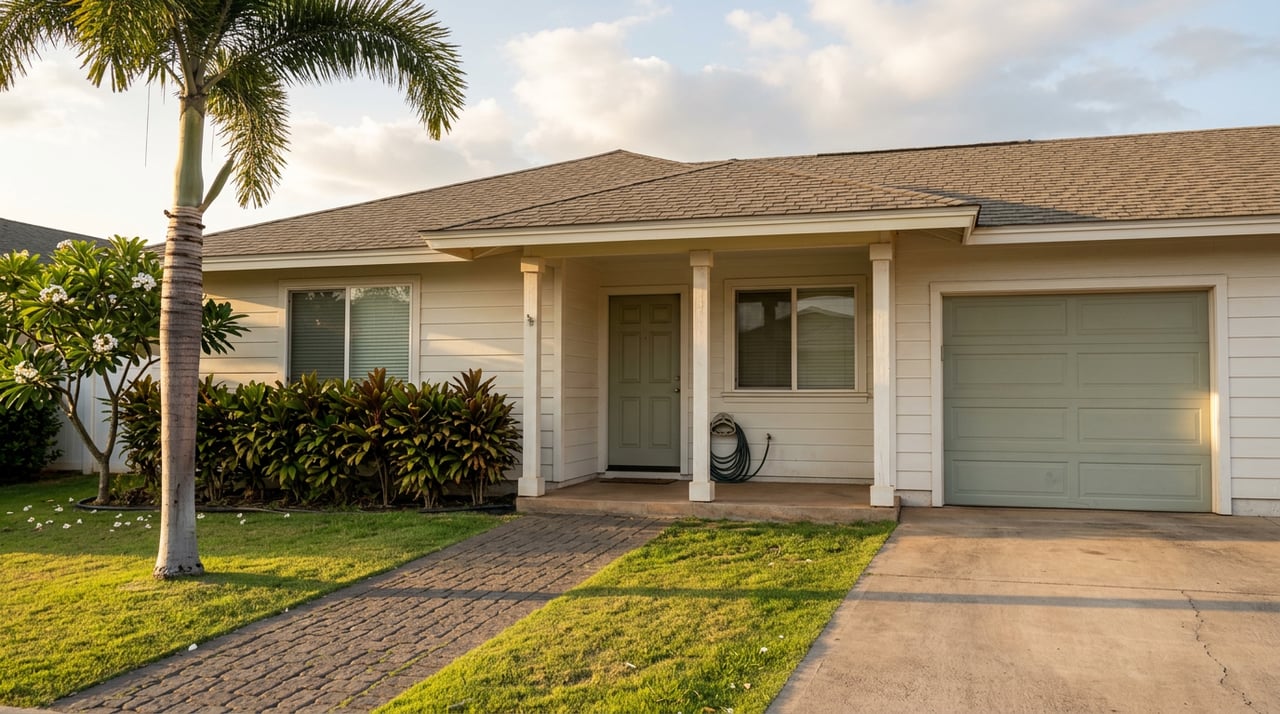
The Fire Isn't What's Splitting Lahaina's Housing Market Anymore
August 13, 2026
August 13, 2026
Maui's countywide numbers for March 2026 read like a contradiction. Single-family home sales jumped 57.1 percent year over year, with 77 units closing that month, while the median sale price fell 7.3 percent to $1,200,000. Condo sales rose 21.3 percent to 74 units, yet the median condo price dropped 17.7 percent to $675,000. More buyers were closing deals, and prices kept sliding.
I've had a version of this conversation a dozen times this year with people trying to decide where to buy in Lahaina. They pull up that median, assume it describes one recovering, discounted town, and start comparing price per square foot the way they would in any normal market reset. That's the wrong read. The number they're looking at isn't measuring fire recovery anymore. It's measuring three markets that no longer move together, and the thing separating them isn't proximity to the burn zone. It's zoning.
That March figure covers all of Maui, from Kahului to Kihei to Lahaina, and it gets pulled hard by West Maui's condo stock specifically. A lot of that stock sits on Maui County's Minatoya List, the roughly 6,208 apartment-zoned units that operated as short-term rentals for decades. About 36 percent of those units are in West Maui, concentrated in and around Lahaina and Kaanapali.
Bill 9, the ordinance Mayor Richard Bissen signed on December 15, 2025 after a 5-3 County Council vote, ends that exemption. Apartment-zoned short-term rentals in West Maui have to stop operating as such by January 1, 2029. Everywhere else in the county, the deadline is January 1, 2031. That single piece of legislation is doing more to reshape condo pricing in Lahaina right now than the rebuild itself.
Once you sort Lahaina's condo and townhome stock by zoning classification instead of by street address, the countywide median starts to make sense as an average of genuinely different situations.
| Zoning bucket | Example communities | Bill 9 status | What's happening to price |
|---|---|---|---|
| Residential, never a TVR | Kahoma Village, Hoonanea, Opukea | Doesn't apply. These were built and sold as long-term housing | Held close to pre-fire levels |
| Apartment-zoned, Minatoya List | Lahaina Roads | Must end short-term rental use by January 1, 2029 | Pricing meaningfully below comparable non-Minatoya units |
| Hotel-zoned | Kaanapali Shores | Explicitly exempt from Bill 9 | Priced on rental performance, not on a regulatory deadline |
Kahoma Village, built by Stanford Carr between 2018 and 2020, was designed from the start as long-term residential housing, right off Historic Front Street with three parks. Hoonanea, completed in 2010 by DR Horton, and Opukea, the older of the two, sit in the same category. None of these three communities were ever entangled in the Minatoya List fight because none of them were ever operating as vacation rentals in the first place.
That's why their pricing looks so different from the headline condo median. Current listings across the three communities cluster in a fairly tight band, with 3-bedroom units generally landing somewhere between $700,000 and $900,000 depending on floor plan and finish, and larger stand-alone homes within Kahoma Village pricing well above a million. That's a market driven by the same thing that's driven it for years: Maui's persistent shortage of long-term housing, a shortage the 2023 fire only deepened by displacing roughly 12,000 people. Owner-occupants and long-term renters keep showing up for these units because the underlying demand for a place to actually live in West Maui never went anywhere.
Lahaina Roads sits directly on the water along Front Street, largely spared physical damage in the fire, and its units are trading noticeably below what an oceanfront Front Street address would normally command. That's not a fire-damage discount. Lahaina Roads is apartment-zoned and on the Minatoya List, which means every buyer is pricing in a hard stop on short-term rental income no later than January 1, 2029.
The math behind that deadline is getting less forgiving, not more. In late February 2026, Maui Now reported that the Maui Planning Commission voted 5-1 to recommend denial of a proposed rezoning that would have created new H-3 and H-4 hotel districts and let roughly 4,500 of the affected units keep operating as vacation rentals. Commissioner Mark Deakos, who introduced the motion, argued the rezoning was a way to undermine what the council had already decided. Bill 9 passed with five votes. Maui Now reported that a group of owners at the Kaanapali Royal complex filed the first legal challenge on December 19, 2025, arguing the phase-out amounts to an unconstitutional taking of property rights under the Hawaii Constitution. A second suit followed. Staystra reported that, as of this spring, neither had produced an injunction.
One detail matters a lot if you're evaluating a Minatoya-list unit as an investment rather than a home: roughly 94 percent of the affected units are owned by people who don't live in Maui County. This is overwhelmingly an absentee-owner and investor situation, which is exactly why the pricing discount shows up as a market-wide pattern instead of a handful of one-off sales. Buyers are underwriting a legal and regulatory outcome, not a construction timeline.
Kaanapali Shores is the cleanest counter-example. It's hotel-zoned, explicitly outside Bill 9's reach, and current listings there are marketed plainly as short-term rentals. A different kind of discount shows up at Lahaina Shores, on Front Street itself, which reopened after extensive fire-related renovations with asking prices running roughly 35 percent below pre-fire values. That discount has nothing to do with regulatory risk. It's tied to the building's own recovery timeline, the same kind of discount you'd expect on any renovated property re-entering a market, and it should narrow as the building's track record post-reopening lengthens. The Minatoya discount, by contrast, doesn't close with renovation. It closes with a legislative outcome that hasn't happened yet.
This week marks three years since the August 8, 2023 fire, and the numbers as of early August 2026 tell a specific story. Governor Josh Green's office reported on August 3 that 100 percent of debris has been cleared and that 667 building permits have been issued with 577 houses completed across the wildfire-affected areas. Reporting from Maui Now on August 2 put the Lahaina-specific figure at 557 homes rebuilt as of August 1, with hundreds more permitted or in process.
Front Street's commercial core is a different pace entirely. As of the same week, not one recovery building permit had been issued for a commercial property destroyed on Front Street. Five properties, including 612 Front Street, once home to the Pacific Whale Foundation and Maui Hands Art Gallery, and 632 Front Street, the former Paia Fish Market, had cleared historical district approval, a step short of an actual building permit. Ryan Churchill of Pacific Rim Land, which manages 612 Front Street for owner AJI LLC, said in late July that the property needs only final county sign-off before permits can be issued. In the meantime, the county launched 'Ulu o Lele, an interim marketplace developed with the nonprofit Hawaiian Council, meant to give displaced businesses a place to operate for about two years while permanent rebuilding proceeds.
If you're weighing Lahaina against another West Maui or South Maui neighborhood, the fire timeline matters less to your pricing than the zoning classification of the specific building you're looking at. Before you compare price per square foot across two condos, find out whether either one sits on the Minatoya List. A unit priced below its neighbors on Front Street might be a genuine value if you plan to live in it or rent it long-term. The same unit priced the same way is a very different bet if your plan depends on short-term rental income past 2029.
For anyone buying to live in West Maui rather than to run a vacation rental, communities like Kahoma Village, Hoonanea, and Opukea deserve a closer look than their modest name recognition suggests. They've spent three years proving that Lahaina's residential demand never actually left. The regulatory story and the rebuild story are both still being written, but that part of the market already has its answer.
Does buying inside the burn zone automatically mean I'm buying into short-term rental risk? No. Plenty of properties in and around the burn zone, including Kahoma Village, Hoonanea, and Opukea, were never operated as vacation rentals, so Bill 9 has no bearing on them at all.
How do I find out if a specific Lahaina condo is on the Minatoya List? Ask directly, and ask early. The list itself is organized by Tax Map Key and isn't the easiest document to read cold, so I'd rather pull that answer for you before you write an offer than have you discover it during due diligence.
Could Bill 9 still get overturned before the 2029 deadline? Two lawsuits were active as of this spring, with no injunction issued in either case. The Planning Commission's 5-1 vote against the rezoning workaround in February 2026 made a legislative fix less likely, though not impossible. I'd plan around the law as written today rather than around a repeal that hasn't happened.
If you're trying to figure out which side of this split a specific Lahaina property falls on, or how any of this compares to what's happening in Kaanapali, Kihei, or Upcountry right now, I'd rather walk you through the actual zoning and comps than let a countywide median make the decision for you. Let's Connect.
This article is general information, not legal, tax or financial advice. Consult a qualified professional about your situation.
Stay up to date on the latest real estate trends.
Work with Harry Devery and experience a higher standard of real estate in Maui. With deep local knowledge, strategic insight, and a commitment to your goals, Harry ensures every step of your buying or selling journey is handled with precision and care. From first consultation to closing, you’ll have a trusted expert by your side.
HARRY DEVERY
3750 Wailea Alanui Dr Ste B16 Kihei, HI 96753